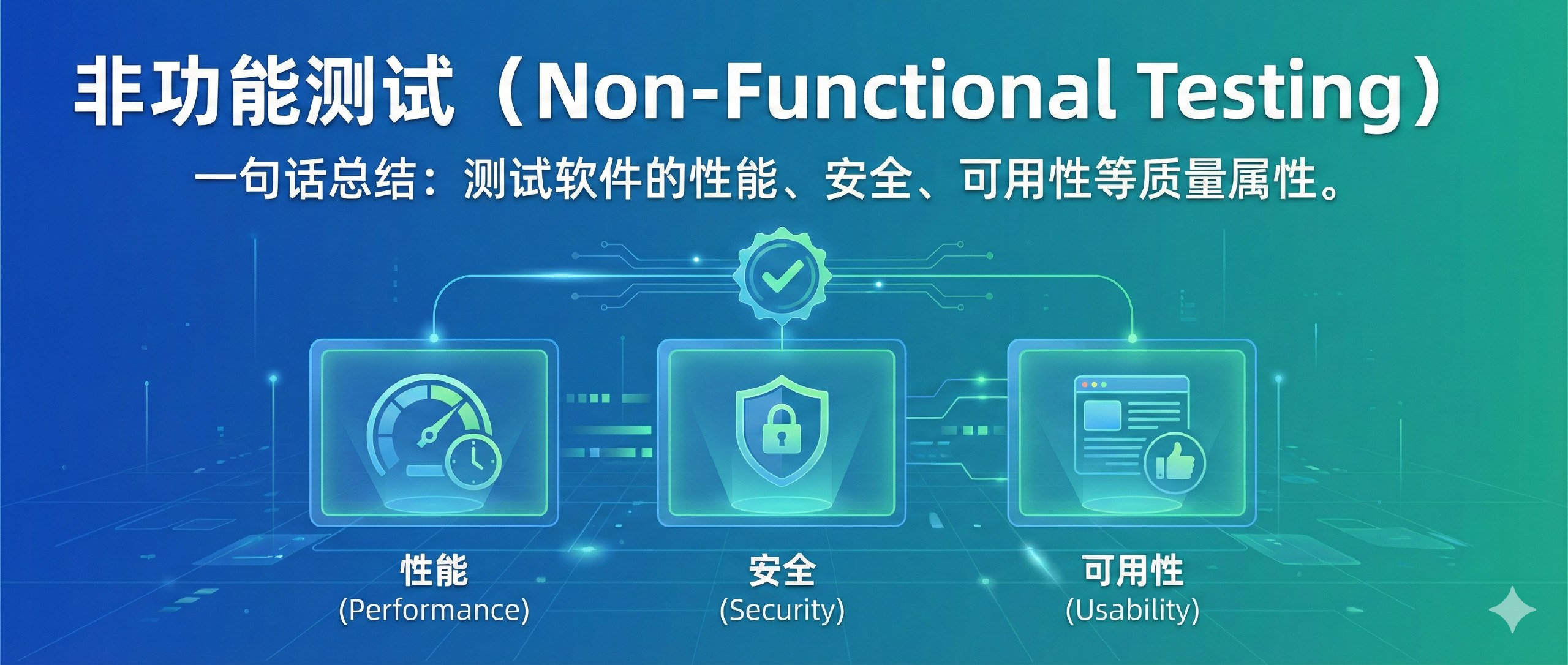
非功能测试(Non-Functional Testing)
一句话总结:测试软件的性能、安全、可用性等质量属性。
🌟 快速理解
功能测试 vs 非功能测试:
1
2
3
4
5
6
7
8
9
10
| 功能测试(What):
- 能登录吗?✅
- 能搜索吗?✅
- 能下单吗?✅
非功能测试(How):
- 登录速度快吗?⚡
- 能承载多少用户?📊
- 数据安全吗?🔒
- 界面好用吗?🎨
|
📌 核心概念
什么是非功能测试?
非功能测试:测试软件的质量属性,如性能、安全性、可用性、可靠性等。
功能 vs 非功能
| 维度 |
功能测试 |
非功能测试 |
| 关注点 |
做什么 |
怎么做 |
| 测试内容 |
功能是否正常 |
性能、安全、可用性 |
| 示例 |
能否登录 |
登录速度、安全性 |
| 测试时机 |
开发阶段 |
开发后期 |
🔄 非功能测试类型
1. 性能测试 ⚡
测试内容:响应时间、吞吐量、资源使用率
1
2
3
4
5
6
7
8
9
10
11
12
13
14
| from locust import HttpUser, task
class PerformanceTest(HttpUser):
@task
def test_login_performance(self):
self.client.post("/login", json={
"email": "test@example.com",
"password": "password123"
})
|
2. 安全测试 🔒
测试内容:SQL注入、XSS、认证、授权
1
2
3
4
5
6
7
8
9
10
11
12
13
14
| def test_sql_injection():
"""测试SQL注入"""
response = login(
email="admin' OR '1'='1",
password="anything"
)
assert response["success"] == False
def test_xss():
"""测试XSS攻击"""
response = create_comment(
content="<script>alert('XSS')</script>"
)
assert "<script>" not in response["content"]
|
3. 可用性测试 🎨
测试内容:界面友好性、易用性
1
2
3
4
5
6
7
8
9
10
11
| def test_usability():
"""测试可用性"""
assert page.find_element("#login-btn").is_displayed()
response = login("", "")
assert "请输入邮箱" in response["error"]
assert page.find_element("#quick-buy").is_displayed()
|
4. 兼容性测试 🌐
测试内容:浏览器、操作系统、设备兼容性
1
2
3
4
5
6
7
8
9
10
11
| @pytest.mark.parametrize("browser", [
"chrome",
"firefox",
"safari",
"edge"
])
def test_browser_compatibility(browser):
"""测试浏览器兼容性"""
driver = get_driver(browser)
driver.get("https://example.com")
assert "欢迎" in driver.page_source
|
5. 可靠性测试 🛡️
测试内容:系统稳定性、容错能力
1
2
3
4
5
6
7
8
9
10
11
12
13
14
15
| def test_reliability():
"""测试可靠性"""
for i in range(10000):
response = get_products()
assert response.status_code == 200
stop_database()
response = get_products()
assert response["error"] == "服务暂时不可用"
start_database()
response = get_products()
assert response.status_code == 200
|
6. 可扩展性测试 📈
测试内容:系统扩展能力
1
2
3
4
5
6
| def test_scalability():
"""测试可扩展性"""
for users in [100, 1000, 5000, 10000]:
response_time = load_test(users=users)
assert response_time < 1000
|
📊 最佳实践
1. 定义明确的指标
1
2
3
4
5
6
7
8
9
10
11
12
13
14
15
|
performance_metrics = {
"response_time": "< 500ms",
"throughput": "> 1000 TPS",
"cpu_usage": "< 80%",
"memory_usage": "< 70%"
}
security_metrics = {
"sql_injection": "防护",
"xss": "防护",
"csrf": "防护",
"authentication": "强制"
}
|
2. 使用专业工具
| 测试类型 |
推荐工具 |
| 性能测试 |
Locust, K6, JMeter |
| 安全测试 |
OWASP ZAP, Burp Suite |
| 可用性测试 |
UserTesting, Hotjar |
| 兼容性测试 |
BrowserStack, Sauce Labs |
3. 集成到CI/CD
1
2
3
4
5
6
7
8
9
10
11
12
13
14
15
|
name: Non-Functional Tests
on: [push]
jobs:
performance-test:
runs-on: ubuntu-latest
steps:
- run: locust -f test_performance.py --headless
security-test:
runs-on: ubuntu-latest
steps:
- run: zap-baseline.py -t https://example.com
|
🔗 相关主题
- [[功能测试]] - 测试功能是否正常
- [[性能测试]] - 非功能测试的一种
- [[安全测试]] - 非功能测试的一种
💡 快速参考
1
2
3
4
5
6
7
8
9
10
11
12
13
14
15
16
17
18
19
20
21
22
23
24
25
26
27
| 非功能测试速查表
================
定义:测试软件的质量属性
测试类型:
1. 性能测试(速度、吞吐量)
2. 安全测试(SQL注入、XSS)
3. 可用性测试(易用性)
4. 兼容性测试(浏览器、设备)
5. 可靠性测试(稳定性)
6. 可扩展性测试(扩展能力)
功能 vs 非功能:
- 功能:做什么(What)
- 非功能:怎么做(How)
推荐工具:
- 性能:Locust, K6
- 安全:OWASP ZAP
- 兼容:BrowserStack
最佳实践:
1. 定义明确的指标
2. 使用专业工具
3. 集成到CI/CD
4. 定期测试
|

.png)
.png)
.jpeg)
.png)
.png)
 .png)

.png)
.jpg)


